Best Logic Games and Brain Teasers for Kids
Affiliate links. Some links in this article earn us a small commission if you buy through them, at no extra cost to you. It never changes what we recommend or what we say about it. How we choose what to feature.
Our five logic picks are Rush Hour, Gravity Maze, Kanoodle, The Genius Square and Brainometry. Between them they hold more than 300 set challenges, suit ages 5 to adult, and all but one are designed to be played alone.
Last reviewed 23 November 2026. How things get on our lists is explained on the main picks page.
The 5 picks at a glance
| Pick | What it is | Age guide | Made by |
|---|---|---|---|
| Rush Hour | Sliding puzzle game | Ages 8 and up | ThinkFun |
| Gravity Maze | Marble logic game | Ages 8 and up | ThinkFun |
| Kanoodle | Pocket puzzle game | Ages 7 and up | Educational Insights |
| The Genius Square | Dice puzzle game | Ages 6 and up | The Happy Puzzle Company |
| Brainometry geometry puzzles | Shape puzzle set | Ages 5 and up | Learning Resources |
What are the best logic games for kids?
The best ones start easy and get harder in small steps, so a child keeps going. Rush Hour has 40 challenges from beginner to expert in which you slide vehicles around a grid to free your car. Gravity Maze has 60, built around a marble run. Kanoodle packs more than 200 puzzles into a case that fits in a pocket. The Genius Square adds dice and a race. Brainometry is the gentlest, for ages 5 and up.
What are the best brain teasers for kids?
For a child who likes to sit and work something out, Kanoodle is the pick. The puzzle book shows where a few pieces go and the child has to fit the rest, first flat and later as 3D pyramids. With over 200 puzzles there is always a harder one waiting. The pieces and book all fit inside the case, which measures 14 by 8 by 2 cm.
What are good one player games for kids?
Four of the five games here are built for one player, which makes them useful when a sibling is busy or a parent needs twenty minutes. Gravity Maze is stated by its maker to be for a single player. Rush Hour, Kanoodle and Brainometry are solo challenge games too. The Genius Square can be played alone against a timer or head to head.
What are good puzzle games for 8 year olds?
ThinkFun mark both Rush Hour and Gravity Maze for ages 8 and up, and they suit this age well because the challenge cards go from very easy to properly hard. An 8 year old can also manage Kanoodle, which starts at 7, and will enjoy beating adults at The Genius Square.
What age is Kanoodle for?
The maker suggests Kanoodle for ages 7 and up, and there is no upper limit: the hardest of its 200 plus puzzles will stretch an adult. Younger children who want something similar can start with Brainometry, which is for ages 5 and up and has 24 larger pieces.
How do you play The Genius Square?
Roll the seven dice and place the blockers on the squares they show. Then race to fill every remaining space on the grid with the nine coloured shapes. The Genius Square comes with two grids so two people can race, or one can play against the clock. The maker says there are 62,208 possible layouts and that each has at least one solution. It is for ages 6 and up.
What is Gravity Maze?
Gravity Maze is part marble run, part logic puzzle. Each challenge card shows where some of the towers go; the player works out where to put the rest so that a marble dropped in at the start reaches the target. The box has a game grid, 10 towers, 3 steel marbles and 60 challenges. It is for ages 8 and up.
What are the best STEM games for kids?
Logic games count as STEM because they train the planning and testing that engineering and coding rely on. Rush Hour and Gravity Maze are both sold as STEM toys by their maker. The Genius Square won Gold for Best Logic Toy or Puzzle at the 2024 MadeForMums Toy Awards.
What are good brain games for 5 and 6 year olds?
Start with Brainometry, which is for ages 5 and up: a child copies the pattern on a challenge card using 24 colourful shapes, first flat and then in 3D, across ten double sided cards. From 6, The Genius Square works well with an adult, because the dice make every game different.
What is the Rush Hour game?
Rush Hour is a sliding puzzle played on a small grid packed with toy cars and lorries. Each challenge card shows how to set the traffic up, and the aim is to slide vehicles backwards and forwards until your own car can drive out of the exit. The maker says more than 10 million have been sold.
All 5 picks, with photos
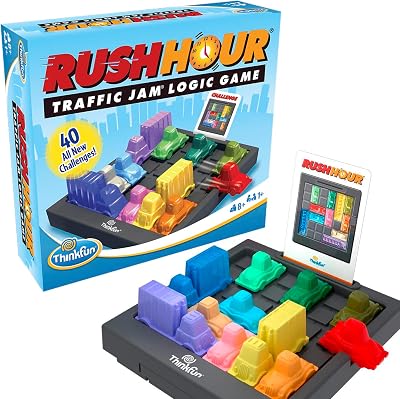
Rush Hour
Why it is here: The traffic jam puzzle: slide the vehicles around until your car can get out. Forty challenges that get harder as you go.
See it on Amazon: Rush Hour
Gravity Maze
Why it is here: A marble run and a logic puzzle in one. Sixty challenges from beginner to expert, for one player.
See it on Amazon: Gravity Maze
Kanoodle
Why it is here: More than 200 puzzles in 2D and 3D, all packed into a case small enough for a pocket.
See it on Amazon: Kanoodle
The Genius Square
Why it is here: Roll the dice, place the blockers, then race to fill the grid with the nine shapes. Play alone or head to head.
See it on Amazon: The Genius Square
Brainometry geometry puzzles
Why it is here: Shape puzzles for one child: 24 pieces and ten double sided challenge cards, covering flat and 3D designs.
See it on Amazon: Brainometry geometry puzzlesAs an Amazon Associate I earn from qualifying purchases. Prices and availability change, so check Amazon for the current details. Reviews and stock last checked 23 November 2026. See every list.
Games like these sit well beside the board games on our maths list and the robots and books on the coding list, which use the same step by step thinking.